Step 4: Blog
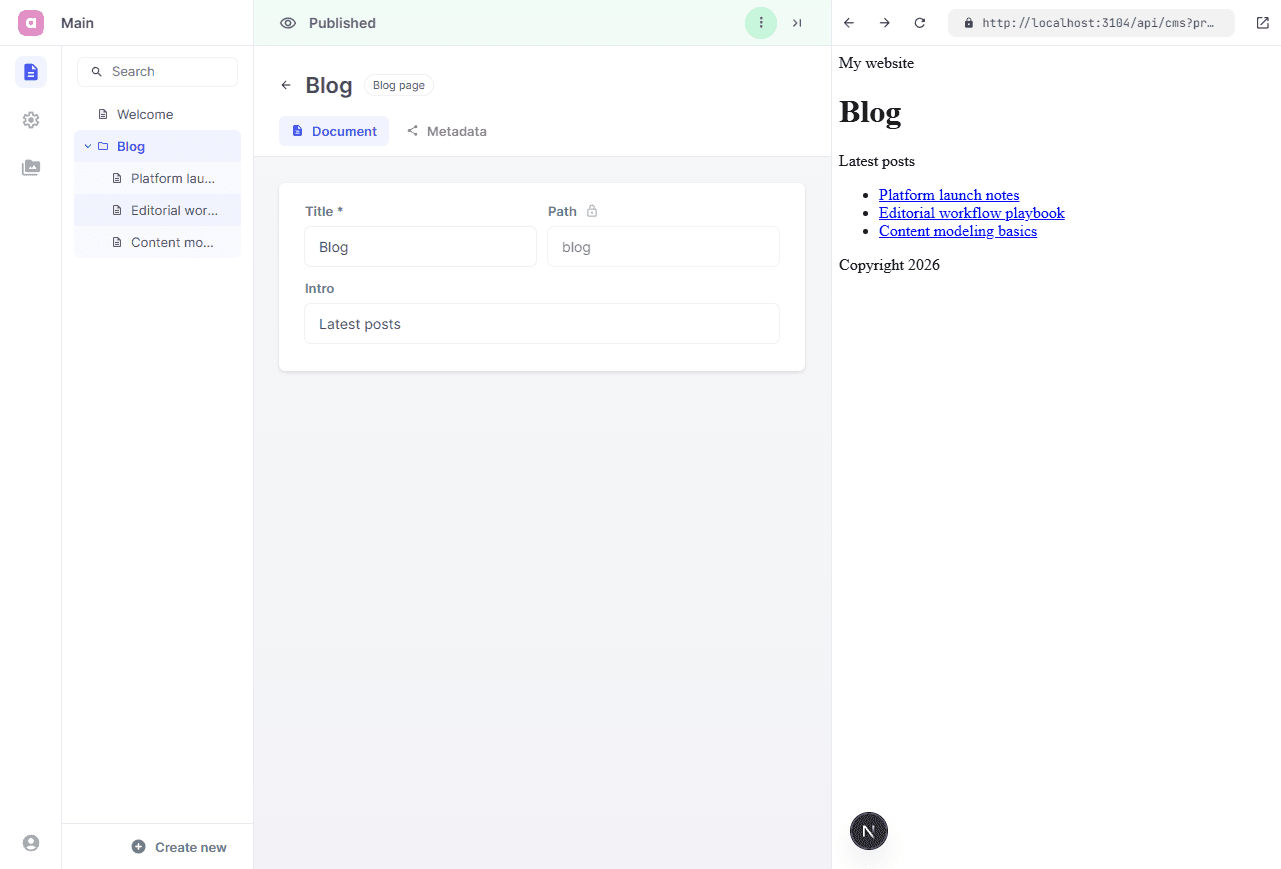
In this step we keep the landing page, blocks, and shared settings root from step 3, then add a dedicated blog section. The blog overview is fixed to /blog and contains nested post pages with editable slugs.
app/
├ page.tsx
├ layout.tsx
├ blog/page.tsx
╰ blog/[slug]/page.tsx

entries/
├ landing/
│ ├ LandingPage.tsx
│ ╰ LandingPage.schema.tsx
├ blog/
│ ├ Blog.tsx
│ ╰ Blog.schema.tsx
├ post/
│ ├ Post.tsx
│ ╰ Post.schema.tsx
╰ settings/
  ├ SiteLayout.tsx
  ╰ SiteLayout.schema.tsx

blocks/
╰ ...

cms.tsx
Start by defining the blog overview entry schema.
import {Config, Field} from 'alinea'

export const Blog = Config.document('Blog page', {
  contains: ['Post'],
  fields: {
    title: Field.text('Title', {required: true, width: 0.5}),
    path: Field.path('Path', {
      readOnly: true,
      initialValue: 'blog',
      width: 0.5
    }),
    intro: Field.text('Intro', {multiline: true})
  }
})
Then implement the blog overview server component. It fetches the blog entry and its direct post children in one query, and exposes generateMetadata.
import {Query} from 'alinea'
import {Entry} from 'alinea/core/Entry'
import type {Metadata} from 'next'
import {notFound} from 'next/navigation'
import Link from 'next/link'
import {cms} from '@/cms'
import {Post} from '@/entries/post/Post.schema'
import {Blog} from './Blog.schema'

type PostLink = {id: string; title: string; url: string}

export async function BlogView() {
  const page = await cms.get({
    url: '/blog',
    type: Blog,
    select: {
      title: Blog.title,
      intro: Blog.intro,
      posts: Query.children({
        type: Post,
        select: {
          id: Entry.id,
          title: Entry.title,
          url: Entry.url
        }
      })
    }
  })
  if (!page) notFound()

  return (
    <main>
      <h1>{page.title}</h1>
      {page.intro && <p>{page.intro}</p>}
      <ul>
        {page.posts.map((post: PostLink) => (
          <li key={post.id}>
            <Link href={post.url}>{post.title}</Link>
          </li>
        ))}
      </ul>
    </main>
  )
}

export async function generateMetadata(): Promise<Metadata> {
  const page = await cms.get({url: '/blog', type: Blog})
  if (!page) return {}

  return {
    title: page.metadata.title || page.title,
    description: page.metadata?.description || page.intro,
    openGraph: {
      title: page.metadata.openGraph.title || page.metadata.title || page.title,
      description:
        page.metadata.openGraph.description ||
        page.metadata?.description ||
        page.intro,
      images: page.metadata?.openGraph.image
        ? [page.metadata?.openGraph.image.src]
        : undefined
    }
  }
}
Define the post entry schema in its own folder.
import {Config, Field} from 'alinea'

export const Post = Config.document('Post page', {
  fields: {
    title: Field.text('Title', {required: true, width: 0.5}),
    path: Field.path('Path', {required: true, width: 0.5}),
    excerpt: Field.text('Excerpt', {multiline: true}),
    body: Field.richText('Body')
  }
})
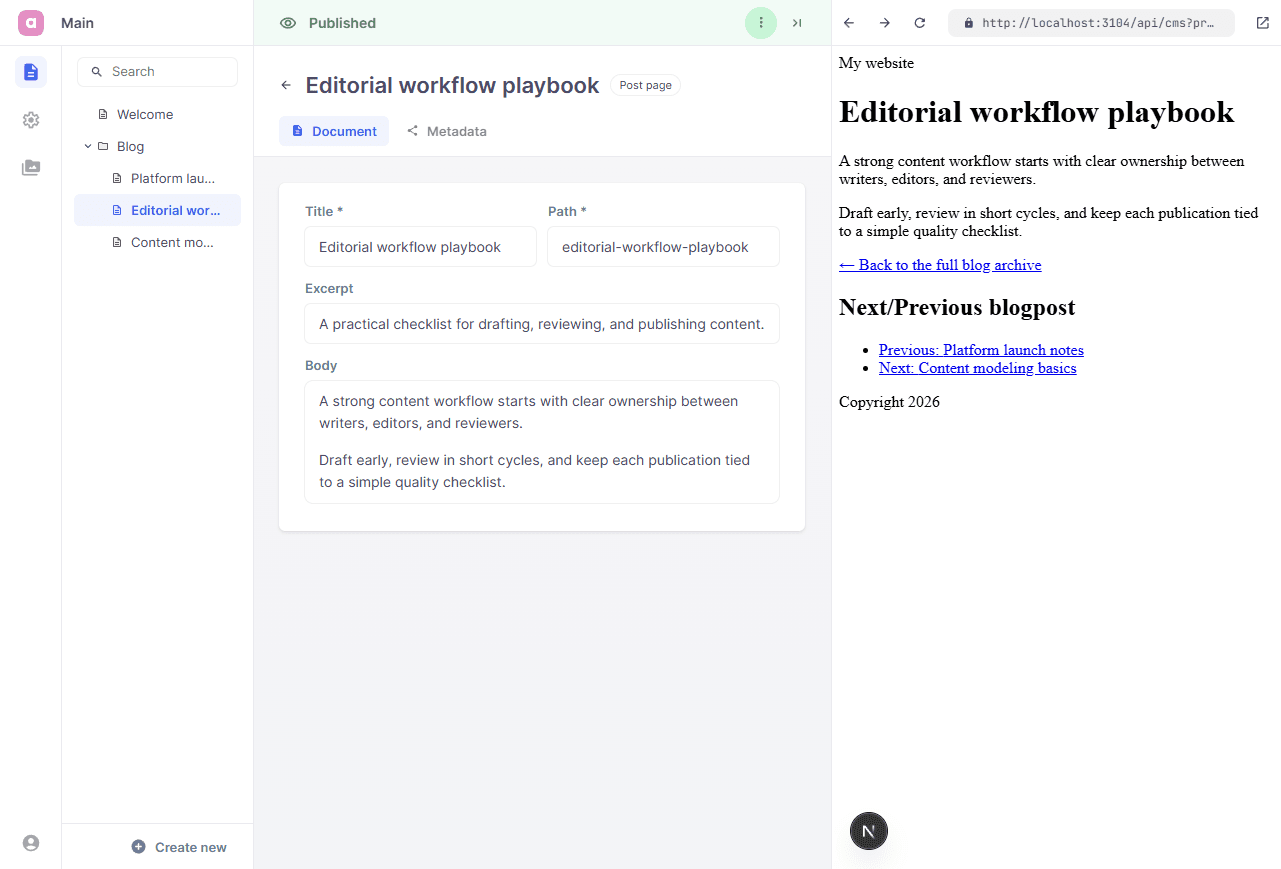
Implement the post detail server component with previous/next sibling navigation and a post metadata helper.
import {Entry} from 'alinea/core/Entry'
import type {TextDoc} from 'alinea'
import {Node} from 'alinea/core/TextDoc'
import {RichText} from 'alinea/ui'
import type {Metadata} from 'next'
import {notFound} from 'next/navigation'
import Link from 'next/link'
import {cms} from '@/cms'
import {Post} from './Post.schema'

type PostLink = {id: string; title: string; url: string; path: string}

export async function PostView({slug}: {slug: string}) {
  const post = await cms.get({url: `/blog/${slug}`, type: Post})
  if (!post) notFound()

  const blogPage = await cms.get({url: '/blog'})
  if (!blogPage) notFound()

  const siblings = await cms.find({
    parentId: blogPage._id,
    select: {
      id: Entry.id,
      title: Entry.title,
      url: Entry.url,
      path: Entry.path
    }
  })

  const index = siblings.findIndex(candidate => candidate.path === slug)
  const previousPost: PostLink | null = index > 0 ? siblings[index - 1] : null
  const nextPost: PostLink | null =
    index >= 0 && index < siblings.length - 1 ? siblings[index + 1] : null

  return (
    <article>
      <h1>{post.title}</h1>
      {typeof post.body === 'string' ? <p>{post.body}</p> : <RichText doc={post.body} />}
      <p>
        <Link href="/blog">← Back to the full blog archive</Link>
      </p>
      {(previousPost || nextPost) && (
        <nav aria-label="Post navigation">
          <h2>Next/Previous blogpost</h2>
          <ul>
            {previousPost && (
              <li>
                <Link href={previousPost.url}>
                  Previous: {previousPost.title}
                </Link>
              </li>
            )}
            {nextPost && (
              <li>
                <Link href={nextPost.url}>Next: {nextPost.title}</Link>
              </li>
            )}
          </ul>
        </nav>
      )}
    </article>
  )
}

export async function generatePostMetadata(slug: string): Promise<Metadata> {
  const post = await cms.get({url: `/blog/${slug}`, type: Post})
  if (!post) return {}

  const bodyText = plainText(post.body)

  return {
    title: post.metadata.title || post.title,
    description: post.metadata?.description || post.excerpt || bodyText,
    openGraph: {
      title: post.metadata.openGraph.title || post.metadata.title || post.title,
      description:
        post.metadata.openGraph.description ||
        post.metadata?.description ||
        post.excerpt ||
        bodyText,
      images: post.metadata?.openGraph.image
        ? [post.metadata?.openGraph.image.src]
        : undefined
    }
  }
}

function plainText(value: TextDoc<any> | string | undefined): string {
  if (!value) return ''
  if (typeof value === 'string') return value

  if (!Array.isArray(value)) return ''
  const result = value
    .reduce((acc, node) => {
      return acc + textOf(node)
    }, '')
    .trim()
  return result.replace(/ +(?= )/g, '')
}

function textOf(node: Node): string {
  if (node._type === 'hardBreak') return '\n'
  if (Node.isText(node)) {
    return node.text ? ' ' + node.text : ''
  } else if (Node.isElement(node) && node.content) {
    return node.content.reduce((acc, node) => {
      return acc + textOf(node)
    }, '')
  }
  return ''
}
Register Blog and Post in cms.tsx and seed the fixed /blog overview page under the Pages root.
import {Blog} from '@/entries/blog/Blog.schema'
import {LandingPage} from '@/entries/landing/LandingPage.schema'
import {Post} from '@/entries/post/Post.schema'
import {SiteLayout} from '@/entries/settings/SiteLayout.schema'

export const cms = createCMS({
  schema: {
    LandingPage,
    SiteLayout,
    Blog,
    Post
  },
  workspaces: {
    main: Config.workspace('Main', {
      roots: {
        pages: Config.root('Pages', {
          contains: ['LandingPage', 'Blog'],
          children: {
            index: Config.page({
              type: LandingPage,
              fields: {
                title: 'Welcome',
                path: ''
              }
            }),
            blog: Config.page({
              type: Blog,
              fields: {
                title: 'Blog',
                path: 'blog',
                intro: 'Latest posts'
              }
            })
          }
        })
      }
    })
  }
})
Add dedicated Next.js routes for /blog and /blog/[slug]. Keep these routes thin and delegate rendering + metadata to entry components.
import {BlogView} from '@/entries/blog/Blog'

export {generateMetadata} from '@/entries/blog/Blog'

export default function BlogRoute() {
  return <BlogView />
}import {Entry} from 'alinea/core/Entry'
import type {Metadata} from 'next'
import {cms} from '@/cms'
import {generatePostMetadata, PostView} from '@/entries/post/Post'
import {Post} from '@/entries/post/Post.schema'
interface PostRouteProps {
params: Promise<{slug: string}>
}
export async function generateStaticParams() {
const paths = await cms.find({
type: Post,
select: Entry.path
})
return paths.map(slug => ({slug}))
}
export async function generateMetadata({
params
}: PostRouteProps): Promise<Metadata> {
const {slug} = await params
return generatePostMetadata(slug)
}
export default async function BlogPostRoute({params}: PostRouteProps) {
const {slug} = await params
return <PostView slug={slug} />
}Upon completion of these steps, your website should be extended with these features:
The landing page from step 3 keeps working with text, image, and weather blocks.
A fixed /blog overview page is seeded and available right away.
Individual blog post pages support previous/next navigation between sibling posts.
Metadata generation is implemented for the blog listing and post detail routes.